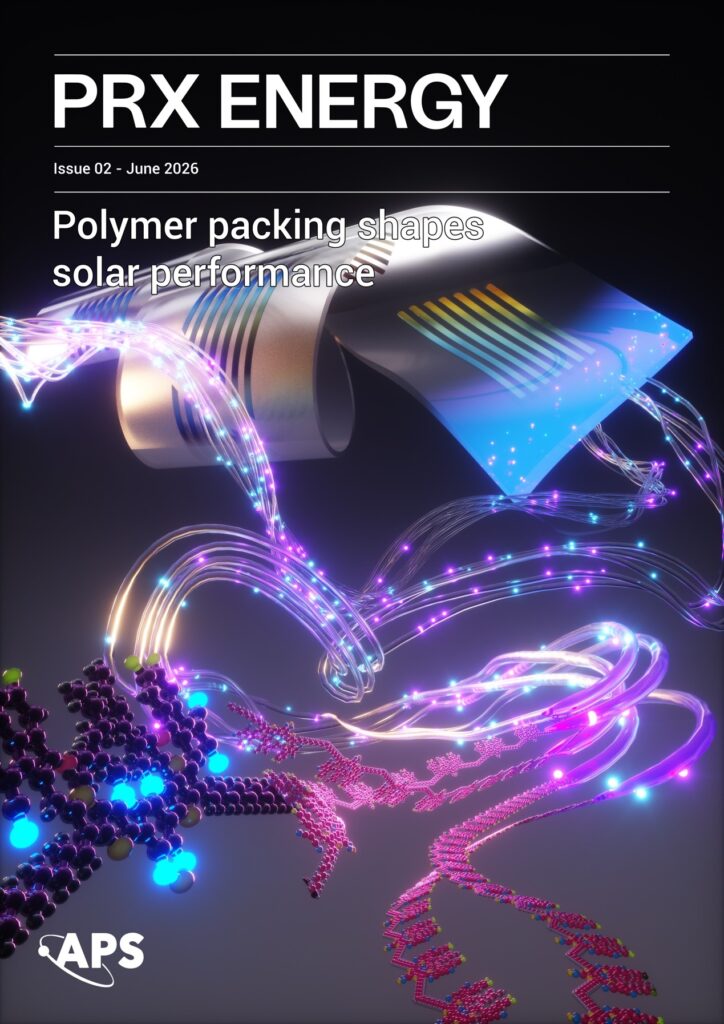
A research team led by Professor Philip C. Y. Chow from the Department of Mechanical Engineering at the University of Hong Kong (HKU) has achieved significant advancements in the field of organic solar cells (OSCs). Their study elucidates critical molecular and structural characteristics that enhance the efficiency of polymer-based OSCs. Published in PRX Energy—a journal of the American Physical Society—under the title ‘Balanced intra- and interchain exciton delocalization enables efficient all-polymer solar cells,’ this work was also featured as a cover article.
OSCs represent a promising emerging technology for harnessing sustainable solar energy in urban buildings and wearable devices, owing to their high mechanical flexibility, lightweight nature, low-cost solution processing, and environmentally friendly (non-toxicity) properties. With improvements in power conversion efficiency and device stability over extended operational periods, OSCs are poised to complement existing solar technologies primarily based on inorganic semiconductors.
Polymerized Y-type acceptors have emerged as promising materials for achieving both efficiency and stability in OSCs. Nevertheless, the influence of their molecular structures on electron-hole dynamics and overall solar cell performance has remained poorly understood. The current research sheds light on this crucial aspect, paving the way for further advancements in all-polymer solar cell design.
Using advanced spectroscopic and structural characterization techniques, the researchers examined how excitons (electron-hole pairs created after light absorption) spread along individual polymer chains and between neighboring chains. They identified trapped excitons associated with structural disorder, which is strongly correlated with solar-cell performance. The researchers further revealed that high-performance polymer acceptors require both extended backbone conjugation and uniform, oriented packing between neighboring polymer chains.
These findings provide new guidelines for designing polymer acceptors and offer a clearer understanding of how molecular structure, structural disorder and exciton behavior affect the efficiency of all-polymer OSCs.
The study was conducted in collaboration with researchers from The Chinese University of Hong Kong and South China University of Technology. Dr. Yu Guo, a postdoctoral researcher in Professor Chow’s group at HKU, was the first author of the study.
About the paper:
Yu Guo, Yuang Fu, Xianzhao Liu, Youcai Liang, Fei Huang, Xinhui Lu, and Philip C.Y. Chow and Philip C. Y. Chow*. Balanced intra- and interchain exciton delocalization enables efficient all-polymer solar cells. PRX Energy 2026, 5, 023008.
Link to the paper: https://journals.aps.org/prxenergy/abstract/10.1103/fls9-jc34.
About Professor Philip C. Y. Chow
Professor Philip C. Y. Chow received his B.Sc. from Imperial College London, and M.Phil. and Ph.D. from the University of Cambridge. He is currently an Assistant Professor and the Associate Head of Department (Teaching & Learning) in the Department of Mechanical Engineering at HKU. His multidisciplinary research group at HKU focuses on the study and development of optoelectronic and photonic devices with applications in solar energy, wearable electronics and green buildings. He was awarded the UK EPSRC Doctoral Training Award in 2010, JSPS Overseas Postdoctoral Research Fellowship in 2016, the Hong Kong RGC Early Career Scheme in 2022, and the NSFC Excellent Young Scientist Fund in 2022.